Which is heavier: 1 kilogram of cotton, or 1 kilogram of iron?
You'd say they weigh the same, and on a scale they do. In logistics and shipping, though, the size of the shipment counts too. A parcel can be very large and still be light, and that parcel takes up more of the carrier's vehicle. The customer is then charged for the space the parcel occupied rather than for what it actually weighs — and that charge is based on its volumetric weight. In this guide, you'll learn what volumetric weight is, which weight carriers bill on, how to calculate it step by step, and how to keep it down.
Volumetric weight is the weight of a shipment calculated from its dimensions rather than from a scale. Measure length, width, and height in centimeters, multiply them together, then divide by the carrier's dimensional factor, which is 5000 for air freight. Carriers charge on whichever is greater: actual weight or volumetric weight.
📌 Article overview
- What is volumetric weight?
- Does the carrier bill on actual or volumetric weight?
- How to find your product's dimensions
- How to calculate the volumetric weight of a parcel
- Frequently asked questions
🎯 What is volumetric weight?
Volumetric weight is the weight of a parcel worked out from its size, or its dimensions. It reflects the space the box takes up relative to how dense it is.
Does the carrier bill on actual or volumetric weight?
Shipping fees are charged on either the actual weight or the volumetric weight. The carrier bills the customer on whichever is greater.
The reason is simple: large shipments with a low actual weight fill a vehicle quickly and force shipping companies to carry fewer parcels, which pushes the cost and the price of shipping up.
So the actual weight is calculated and compared with the volumetric weight, based on the shipment's dimensions, to see which is larger. The larger figure is the one used to work out the shipping price and the final cost of the shipment.
How to find your product's dimensions
Measure the product's length, height, and width using a single unit of measurement, such as centimeters.
👣 How to calculate the volumetric weight of a parcel
1. Measure the dimensions of the shipment or parcel in centimeters.
The dimensions of a shipment or parcel are:
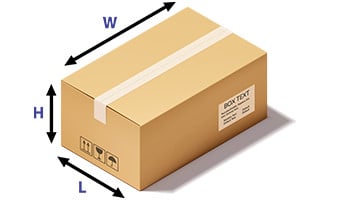
Length
Width
Height
2. Work out the volume of the shipment.
Volume = length × width × height
3. Divide the volume by the dimensional factor.
The dimensional factor is known as (DIM), and it is set by the international shipping companies such as FedEx and UPS.
- Dimensional factor for air freight = 5000
- Dimensional factor for postal shipping = 6000
4. Round the result to the nearest whole number.
💡 Example
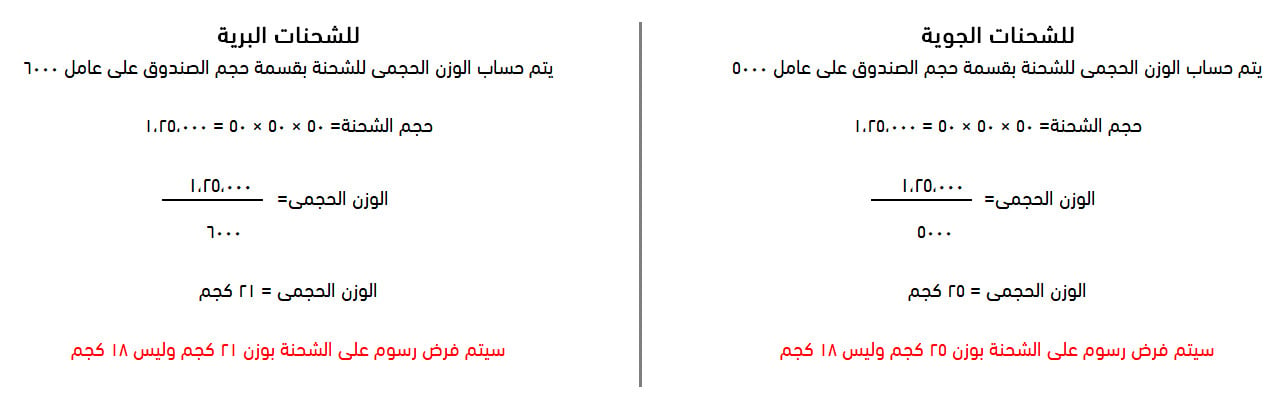
Take a shipment made up of a box measuring 50 × 50 × 50 cm, with an actual weight of 18 kg.
❓ Frequently asked questions
Are there machines that calculate a parcel's volumetric weight?
The actual weight of a box is easy to measure with the electronic scales everyone uses. Very few machines, though, calculate a parcel's volumetric weight accurately.
Do bulges in the shipment affect its volumetric weight?
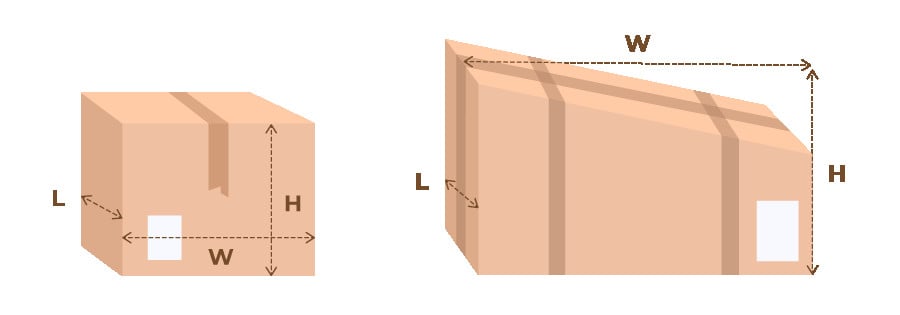
Yes. You have to account for any bulges or misshapen sides. Anything protruding beyond the normal shape counts toward the volumetric weight.
Measure the length, height, and width of your parcel using the furthest point on each side.
Who sets the dimensional factor?
The international shipping companies set it, FedEx and UPS among them. It depends on the type of shipping (air, land, or sea), on the carrier delivering the parcel, and on the destination — whether the delivery is domestic or international.
Different carriers may charge different rates depending on the service type or on their rules in general. For international shipping, the most common volumetric constant is 5000 cm³/kg, though some carriers work to 4000 cm³/kg.
How do I reduce the volumetric weight of my shipments?
1. Use the smallest box you can while still keeping the product safe. A large box means a high volumetric weight, which in turn means higher shipping costs.
2. Work with a shipping agent. Online store owners rarely ship the volumes that earn large discounts from the international companies. Shipping agents handle shipping for hundreds or thousands of merchants, and that combined volume qualifies them for significant discounts, which they can pass straight on to their customers.
Is sea freight treated the same way?
The chargeable weight for sea freight differs slightly from the land and air calculations. For goods carried by sea, there is a split between heavy cargo and light cargo (foam-like goods), and the carrier charges accordingly.
📝 Important notes
Before you set your shipping prices, measure your packaging as well as your products. A box that is one size too big quietly raises the cost of every order you send.