Which is heavier: 1 kilogram of cotton or 1 kilogram of iron?
You might say they weigh the same, and in terms of actual weight, that’s true. But in the world of logistics and shipping, package size matters just as much as weight. A shipment can be large in volume but light in weight, yet it still takes up significant space in a carrier’s vehicle. In such cases, shipping companies charge based on the space the package occupies, not just its actual weight.
That’s where volumetric weight comes in.
This article explains what volumetric weight is, how shipping companies use it, and how you can calculate it accurately to avoid unexpected shipping costs.
📌Article overview
- What is volumetric weight?
- Do shipping companies charge by actual or volumetric weight?
- How to determine product dimensions
- How to calculate volumetric weight
- Frequently asked questions
What is volumetric weight?
Volumetric weight (also known as dimensional weight) is the calculated weight of a shipment based on its volume (dimensions) rather than its actual scale weight.
In simple terms, it represents how much space a package occupies relative to its density. Large but lightweight packages often have a higher volumetric weight than actual weight.
Do shipping companies charge by actual or volumetric weight?
Shipping companies calculate both:
- Actual weight (measured on a scale), and
- Volumetric weight (calculated from dimensions)
The shipping cost is based on whichever weight is greater.
Why? Large, lightweight shipments take up more space in delivery vehicles, which limits how many shipments a carrier can transport at once. This increases operational costs, which is why carriers charge based on space usage when applicable.
As a result:
- Actual weight and volumetric weight are compared
- The higher value is used to calculate the final shipping cost
How do I determine product dimensions?
To calculate volumetric weight, you first need to measure the package dimensions:
- Length
- Width
- Height
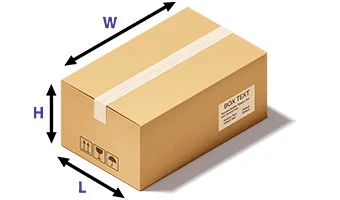
All measurements should be taken using the same unit, typically centimeters (cm).
How to calculate volumetric weight
Follow these steps to calculate the volumetric weight of a package:
Step 1: Measure the package dimensions (in cm)
Package dimensions include:
- Length
- Width
- Height
Step 2: Calculate the package volume
Package volume = Length × Width × Height
Step 3: Divide by the dimensional factor (DIM)
The dimensional factor (DIM) is set by global shipping companies such as FedEx and UPS, and varies by shipping method.
Common dimensional factors include:
- Air freight: 5000
- Postal shipping: 6000
Volumetric weight = (Length × Width × Height) ÷ DIM
Step 4: Round up the result
Always round the final result up to the nearest whole number.
Example: You have a package with the following details
- Dimensions: 50 × 50 × 50 cm
- Actual weight: 18 kg
- Volume = 50 × 50 × 50 = 125,000 cm³
- Volumetric weight (air freight) = 125,000 ÷ 5000 = 25 kg
Result: Even though the actual weight is 18 kg, the shipping cost will be calculated using 25 kg, since volumetric weight is higher.
Frequently asked questions
Are there machines that calculate volumetric weight automatically?
Actual weight can easily be measured using common electronic scales. However, there are very few machines that accurately calculate volumetric weight automatically. Most merchants calculate it manually using measurements.
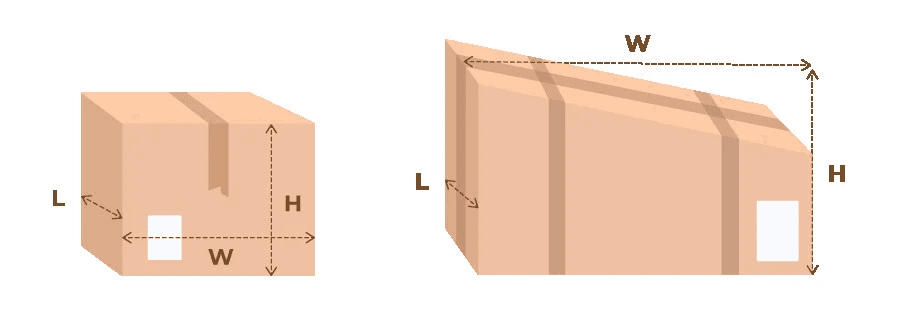
Do bulges or irregular shapes affect volumetric weight?
Yes. Any bulges, deformations, or irregular sides must be included in the measurements.
Always measure:
- Length
- Width
- Height
Using the longest point on each side of the package. These extra dimensions directly impact volumetric weight.
Who determines the dimensional factor (DIM)?
The dimensional factor is set by global shipping companies such as FedEx and UPS, based on:
- Shipping method (air, land, or sea)
- Carrier policies
- Destination (domestic or international)
While 5000 cm³/kg is the most common DIM factor for international shipping, some carriers may use 4000 cm³/kg, depending on their pricing model.
How can I reduce volumetric weight?
To lower volumetric weight and reduce shipping costs:
- Use the smallest possible box that still protects the product
- Avoid oversized packaging
- Optimize packing materials to reduce empty space
You can also benefit from freight forwarders. Individual merchants often ship lower volumes and may not qualify for large carrier discounts. Freight forwarders consolidate shipments for hundreds or thousands of merchants, allowing them to secure better rates and pass those savings on to you.
Is sea freight calculated the same way?
Not exactly. Sea freight uses a slightly different approach. Cargo is often categorized as:
- Heavy cargo, or
- Light (voluminous) cargo
Charges vary based on this classification and the carrier’s pricing rules, making sea freight calculations different from air and land shipping.