Does the same discount go out to every customer in your store, no matter who they are?
Broad, one-size-fits-all promotions are the ones that get ignored. A new shopper, a loyal customer of two years, and someone who just cancelled an order are three different people, and they do not respond to the same offer. With personalized coupons and customer groups in Salla, you can aim each campaign at a specific slice of your audience instead of the whole list. In this guide, you'll learn which conditions you can set on a coupon or an offer, how to split your customers into groups, and nine campaigns you can run with them.
Salla lets you restrict a coupon by customer group, email domain, country, payment method, product, category, or minimum spend. Special offers can be targeted by platform, customer group, and country. Combine those conditions with customer groups and each campaign reaches only the people it was written for.
📌 Article overview
- Targeting options for coupons and special offers
- How to split your customers into groups
- Nine campaigns you can run with targeted coupons
- Frequently asked questions
🧩 Targeting options for coupons and special offers
A general promotion treats every customer the same. Coupon conditions in Salla let you control exactly who can redeem a code and when, based on what the customer buys, where they are, and how they pay — which turns each coupon into a precise marketing tool rather than a blanket discount.
Coupon conditions
You can restrict a coupon by:
- Free shipping
- Excluding discounted products
- Minimum purchase amount
- Payment methods
- Included categories
- Included products
- Included customer group
- Customer email domain
- Customer country
- Excluding categories, brands, or products
- Excluding a customer group
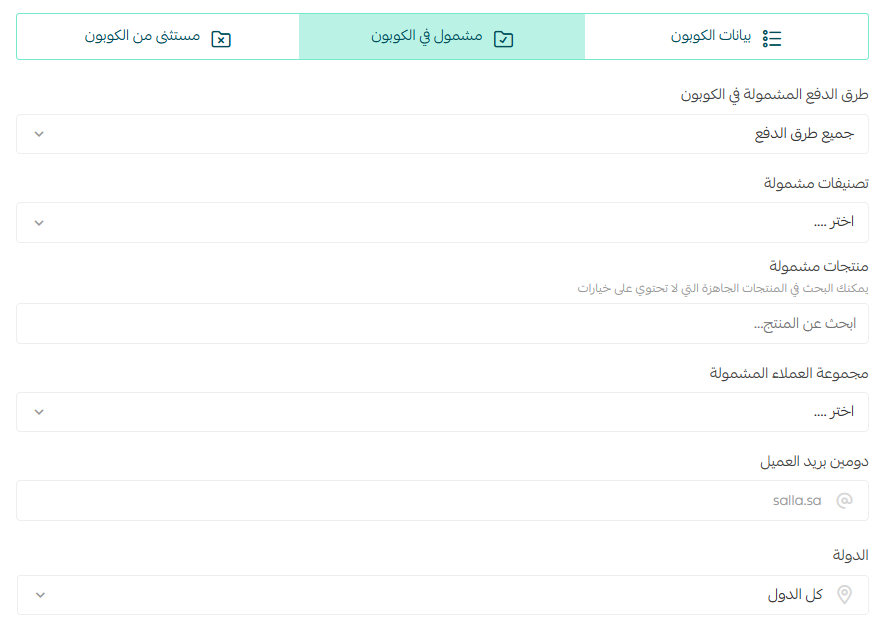
Discount coupons are a loyalty and sales strategy, not just a tool. See how to manage them and get the most out of every code you issue.
Special offer conditions
Special offers can be targeted by:
- Platform (store browser or store app)
- Customer group
- Country
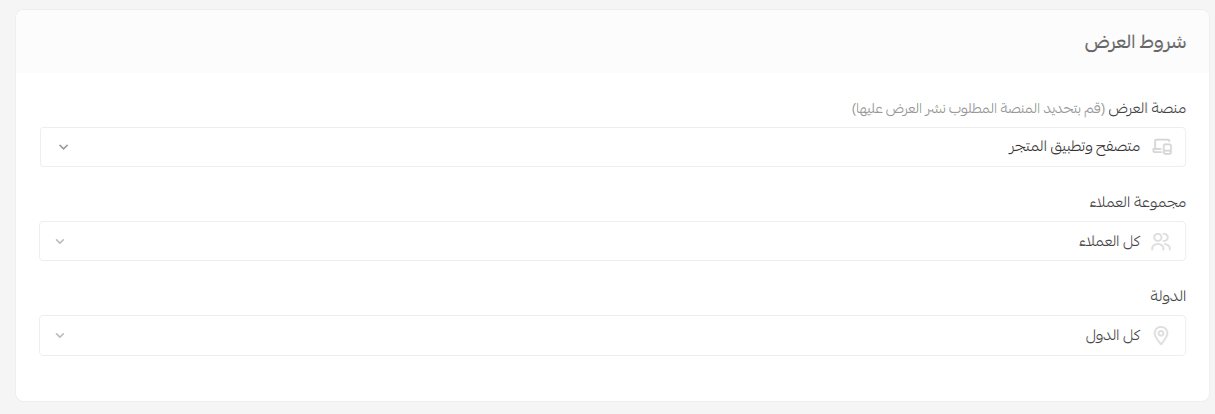
The right offer at the right moment is often all it takes to move sales. This article covers how to build special offers that get noticed and deliver.
👥 How to split your customers into groups
Not every customer in your store is at the same level of interest or buying behavior. Customer groups let you see your audience in slices, then build campaigns for each slice rather than for an average that describes nobody.
You can split your customer base into groups of people who share a characteristic, such as:
- Total purchases
- Number of orders
- Product reviews left
- No orders yet
- No email address on file
- Cancelled orders
- Gender
- Date of birth
- Registration date
- Last login
- Last order
- Customer country
- Customer city
- Order source
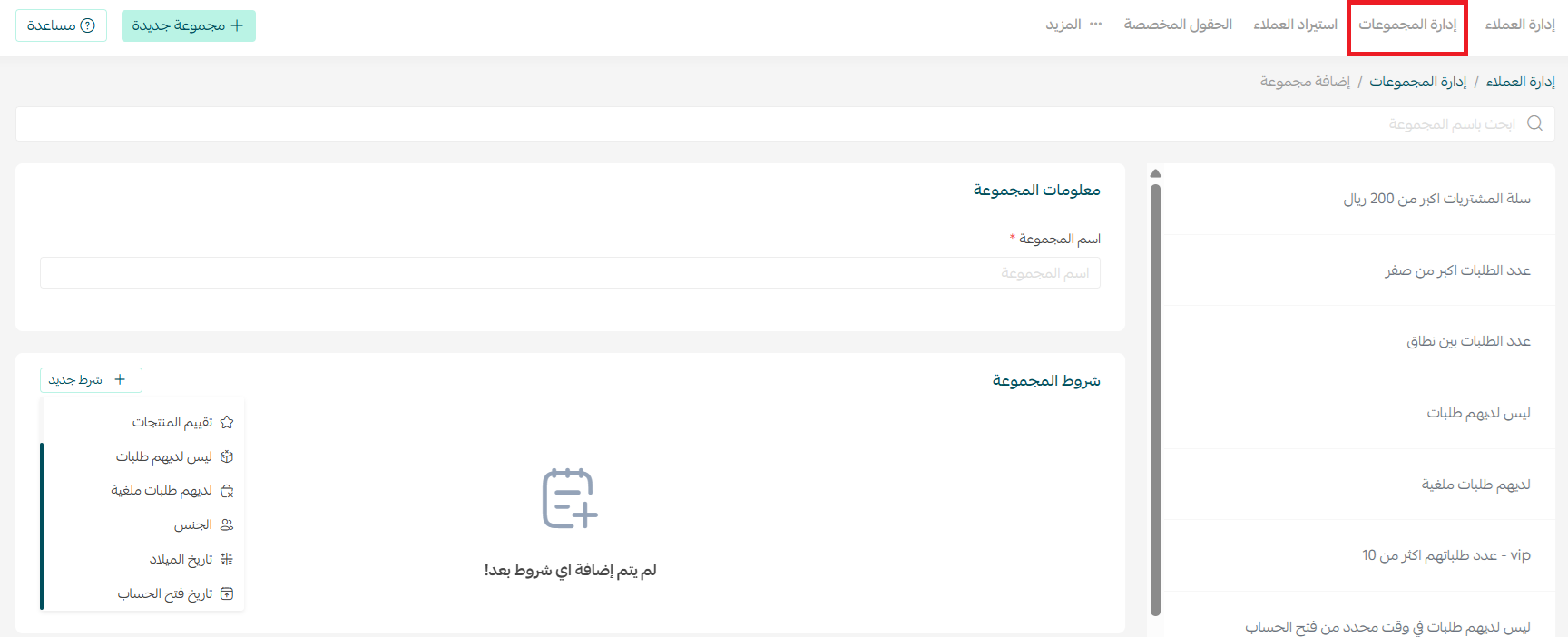
See how customer groups turn a broad marketing plan into precise campaigns that sell more and take less of your time.
💡 Nine campaigns you can run with targeted coupons
1. An exclusive corporate offer
Target a university or a company with a code of their own. It builds the partnership and it builds credibility. Keep the validity short and add something extra, like free shipping, to lift response.
Steps:
- Create a new discount coupon and set its scope by official email domain — @salla.sa or @university.edu, for example.
- Give it a name that says what it is, such as SallaTeam or UNIOFFER.
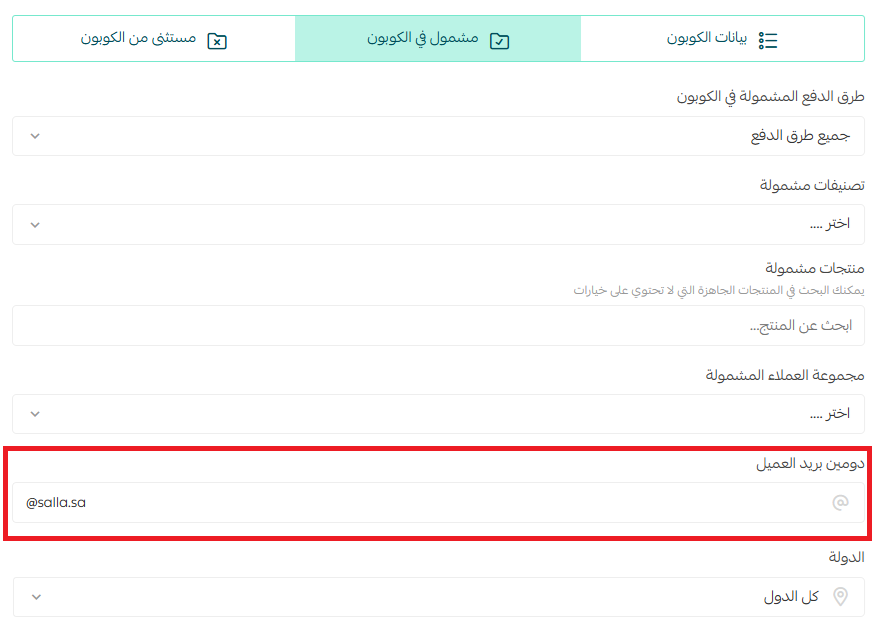
💡 Example: for Saudi Employee Week, a store partnered with a university to give students 20% off all tech products, redeemable with their official university email.
📣 How it was announced: through the university's internal email and its own social accounts.
2. A birthday gift for your customers
An automatic coupon for everyone born this month adds a personal touch and strengthens the tie to your brand.
Steps:
- Create a customer group based on birth month — customers born in May, for example.
- Create a coupon with a celebratory name, such as MAYBIRTHDAYGIFT.
- Set a near expiry date (one week works well) and dress the offer up with a line like "Your birthday gift 🎉".
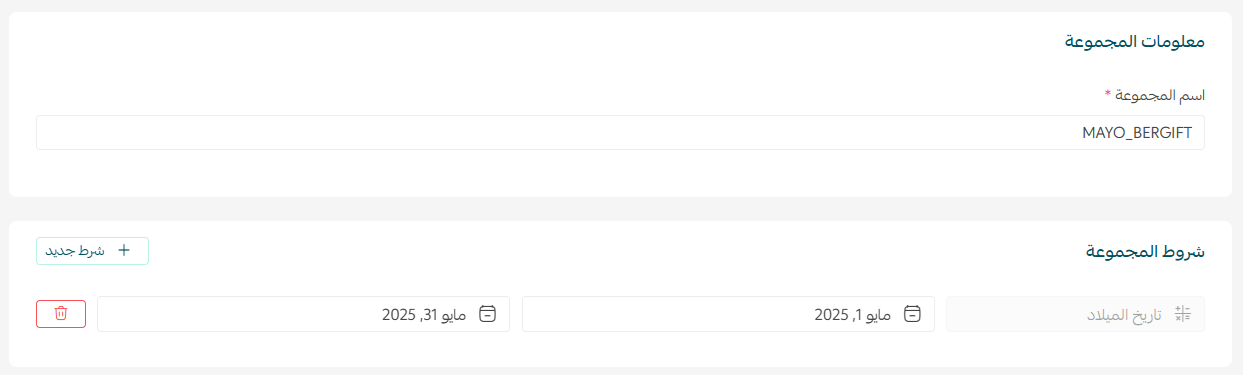
💡 Example: at the start of May, a store sent everyone born that month a congratulations message carrying a 15% coupon plus free delivery, valid for two days only.
3. A year of loyalty deserves an offer
Reward long-standing customers with a code that encourages them to stay. Attach it to a thank-you email that says plainly you value the relationship.
Steps:
- Create a customer group based on registration date — accounts older than one year.
- Create a coupon with a name like LOYALTY10.
- Make the coupon combine a discount, free shipping, and its own usage limit.

💡 Example: on the anniversary of their first sign-up, loyal customers received a message titled "Your first year with us deserves a gift" with a 30% coupon on any product.
💌 How it was sent: a personal email plus an in-store notification.
⏳ Validity: 72 hours only.
4. Making up for a cancelled order
Win back trust with a quick, well-judged offer after a bad experience. Send the coupon with a graceful apology and a line that shows you mean it, such as "your satisfaction matters to us."
Steps:
- Create a customer group of people who cancelled an order.
- Create an apology coupon with a name like SORRY10.
- Set a short validity (one or two days) so the decision happens quickly.

💡 Example: after a campaign that ran into delivery delays, a store apologized to everyone who had cancelled and sent a special coupon along with a guarantee of fast delivery.
📬 How it was promoted: a friendly WhatsApp message opening with "We're sorry — here's something to make up for it 🎁".
5. Buy more, save more
A campaign built to raise average cart value with a single conditional coupon.
Steps:
- Skip the customer group entirely and use the minimum purchase condition on the coupon.
- Set the threshold that unlocks the discount — SAR 300, for example.
- Create a coupon with a name that carries the message, such as BIGGERBETTER.

💡 Example: a store noticed its average cart value slipping and launched a "buy more, save more" campaign. The coupon activates once the cart passes SAR 300.
6. First to try what's new
Give customers who already buy in a category a discount when you launch something new in it. Frame the campaign as an exclusive invitation to try the product before anyone else.
Steps:
- Create a customer group of people who have bought from that category before.
- Create a coupon named after the new product.
- Limit the offer to a specific country or a specific window.

💡 Example: a store launched a new summer fragrance line and targeted customers who had bought perfume before with a coupon that lasted 48 hours.
📣 How it was promoted: an email that opened with "Because you love fragrance, you get the new one first."
7. A surprise coupon during a live stream
Drop a code mid-broadcast to spike engagement and same-hour sales. Tie the reveal to a question or a small challenge so viewers stay to see it.
Steps:
- Create a coupon with a name that stands out, such as LIVE20.
- Set a short validity — the hour of the broadcast only.
- Share the code at a set moment during the stream.
💡 Example: during a TikTok live on how to use a makeup range, a surprise coupon appeared that was valid for 20 minutes.
📺 The teaser: "The code drops at minute 18 only."
8. Thank customers who leave a review
Reward positive reviews with a coupon of their own. Tell the customer their review helps other shoppers, and thank them properly in the message that carries the code.
Steps:
- Create a group of customers who have reviewed a product.
- Create a coupon with a name like THANKSREVIEW.

💡 Example: everyone who reviewed a product in the past week received a 10% coupon for the category they reviewed.
📝 The copy: "Thank you for your review — here's a small token from us."
9. Coupons targeted by gender and interest
Goal: shape each campaign around what that group of customers actually buys.
Steps:
- Create two groups: men and women.
- Create a coupon for each, tied to a matching product category (makeup, men's fragrance).
- Write each offer in a tone that suits its audience.

💡 Example: a store built two separate offers — one discounting skincare for women, the other men's fragrance.
📣 How it was promoted: emails written differently for each group.
❓ Frequently asked questions
Can one coupon use more than one condition?
Yes. You can stack conditions on the same code — a customer group plus a minimum purchase plus free shipping, for example — so the coupon only works for the exact case you had in mind.
What's the difference between a coupon and a special offer here?
Coupons carry the wider set of conditions: email domain, payment method, country, products, categories, customer groups, and minimum spend. Special offers are targeted by platform, customer group, and country.
How do I limit a coupon to one company or university?
Set the coupon's scope by email domain. Only customers whose account uses that domain — @university.edu, for instance — can redeem the code.
Do I need a customer group for every campaign?
No. Some campaigns work off coupon conditions alone. A "buy more, save more" campaign, for example, only needs the minimum purchase condition.
How long should a targeted coupon stay valid?
Keep it short. The examples above run from 20 minutes during a live stream to 48 or 72 hours for loyalty and launch offers — short enough that the customer decides now rather than later.
Pair these conditions with the customer groups you already have and every campaign lands as something built for that person specifically. That feeling is what raises loyalty and multiplies sales.