Pricing an abaya is harder than designing one, and it fails more businesses.
Wrong pricing is the number one reason new abaya stores close. Some merchants price low on the theory that a cheaper price brings more customers, and end up with a margin so thin it doesn't cover their costs. Others price arbitrarily and lose customers they could have won. Neither group is careless — both are guessing, because nobody ever showed them the arithmetic. In this guide, you'll learn how to build an abaya pricing strategy that reflects the real value of what you make, produces a healthy margin, and competes properly in the Saudi market.
To price abayas properly, calculate your full cost per unit, decide which price tier you are competing in, apply a multiplier of 2 to 4 times cost, compare against competitors in the same tier, price on perceived value rather than cost alone, and review every 3 months. That produces a 50% to 75% margin.
📌 Article overview
- Why underpricing is the more dangerous mistake
- The six steps to a smart abaya pricing strategy
- What a healthy margin looks like by tier
- Frequently asked questions
- Further reading
🧭 Why underpricing is the more dangerous mistake
Overpricing is visible. You watch traffic arrive and leave, you get the message, and you adjust. Underpricing is invisible: orders come in, the store looks busy, and the business quietly fails to accumulate anything. By the time the problem is obvious, you have a customer base trained to expect your prices and no easy way to raise them.
There's a second cost that doesn't show up in a spreadsheet. Price is a signal. A customer who cannot judge fabric quality from a photograph uses price as a proxy for it, which means a price set too low actively communicates that the piece is not as good as it is. You end up under-earning on every sale and undermining the perception of your own craftsmanship at the same time.
🧮 How to price your abayas, step by step
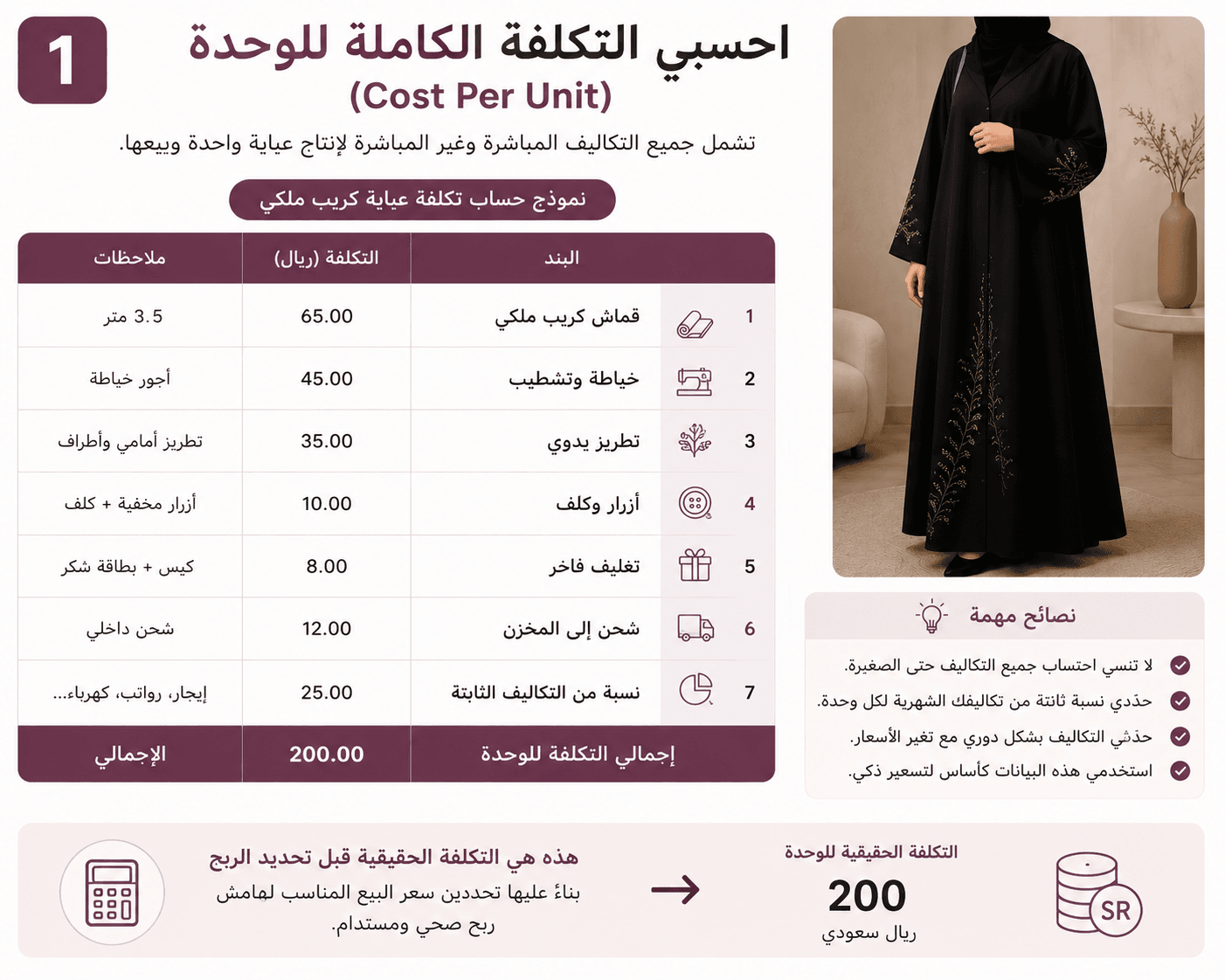
1. Calculate the full cost per unit
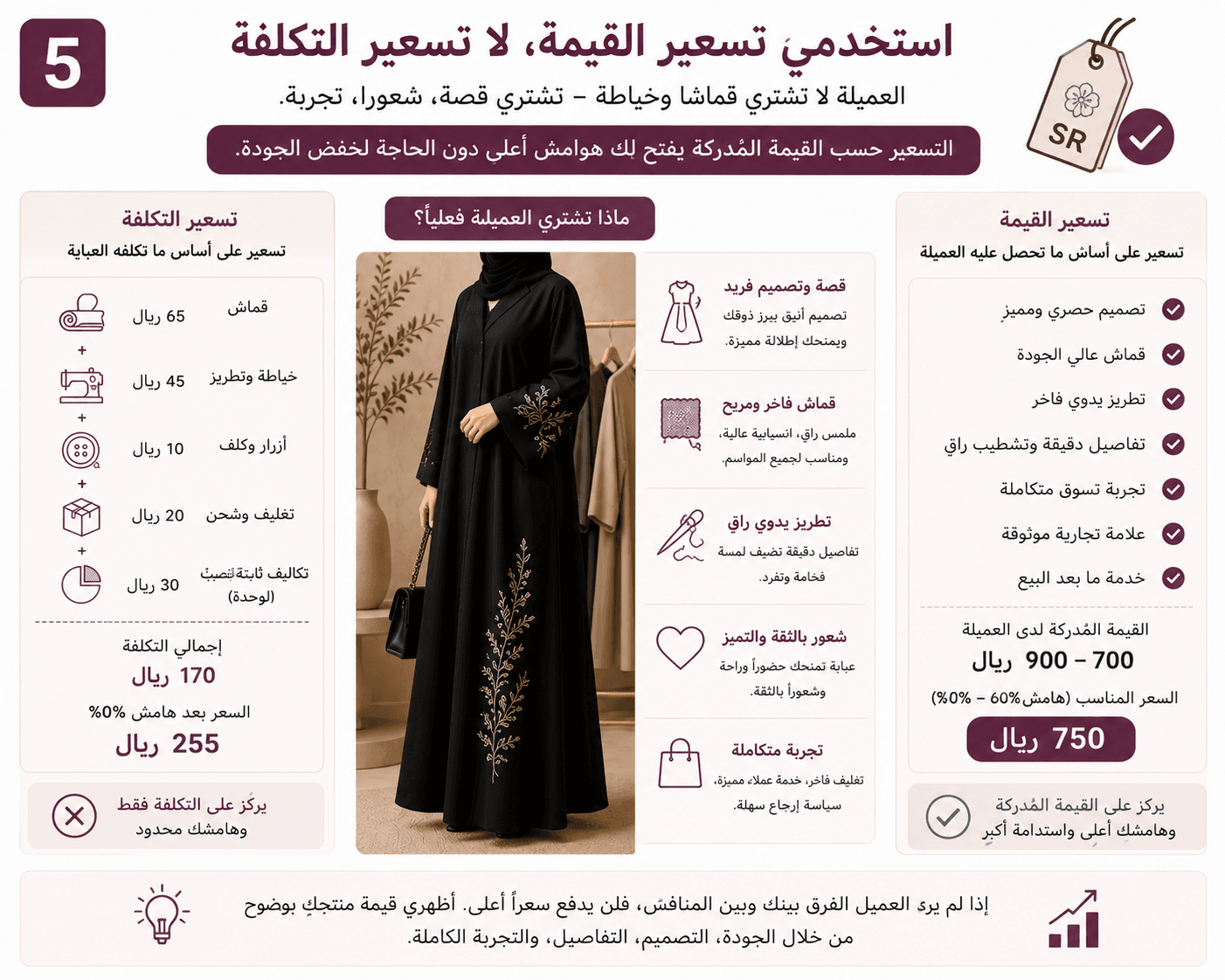
Cost per unit means everything, not just the fabric. Include the fabric, the tailoring, the embroidery, buttons and trims, packaging, shipping into your warehouse, and a share of your fixed monthly costs. That last item is the one most merchants skip, and it is why a store can look profitable per order and lose money per month. Until this number is accurate, every step that follows is built on sand.
2. Decide which price tier you're in
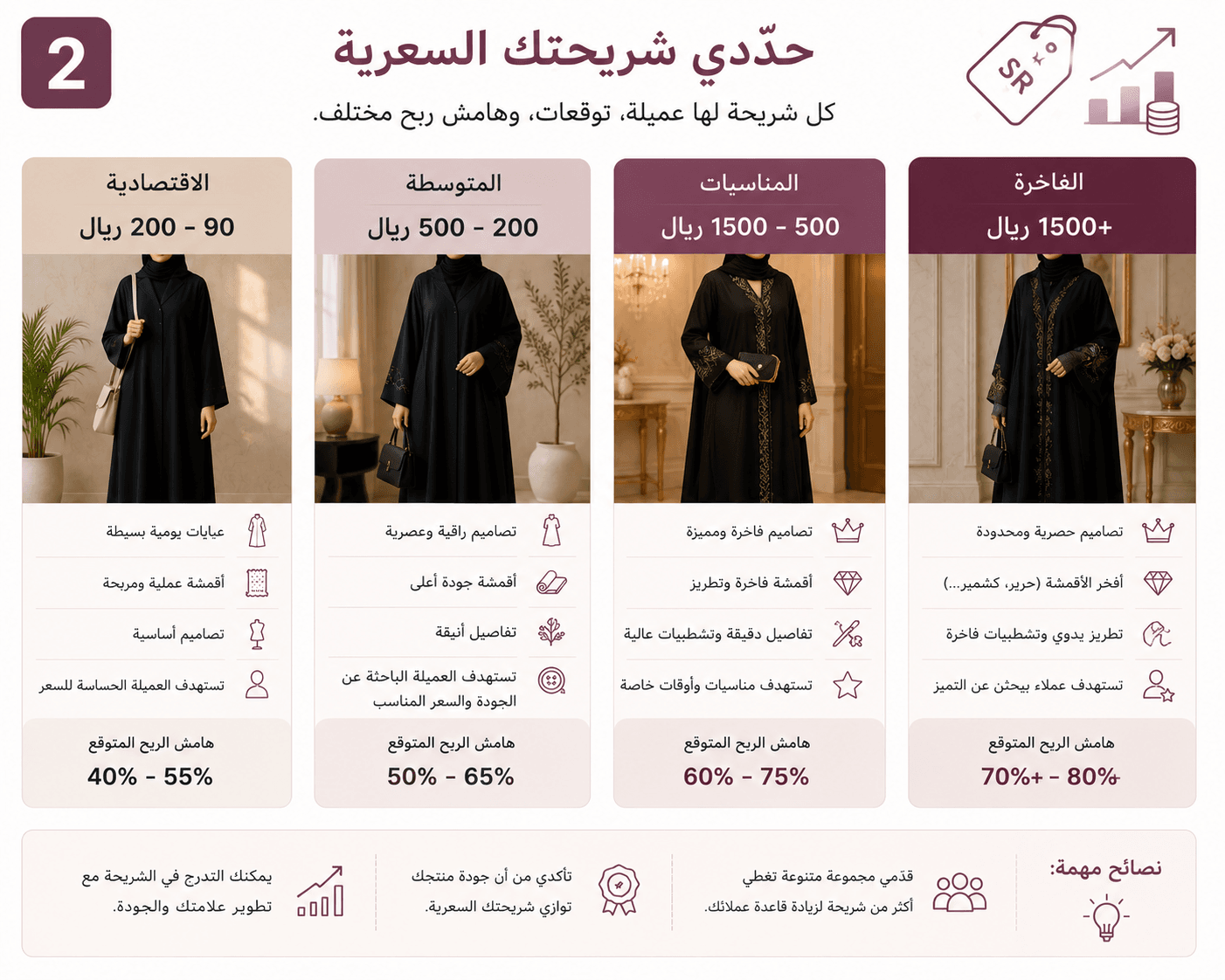
The Saudi abaya market divides into four recognizable tiers, and each one has a different customer, different expectations and a different margin:
- Economy: SAR 90 to SAR 200
- Mid-range: SAR 200 to SAR 500
- Occasion: SAR 500 to SAR 1,500
- Luxury: SAR 1,500 and above
Pick one deliberately. A catalog that scatters across all four confuses the customer about what your brand is, and a confused customer defers the decision.
3. Apply the pricing formula
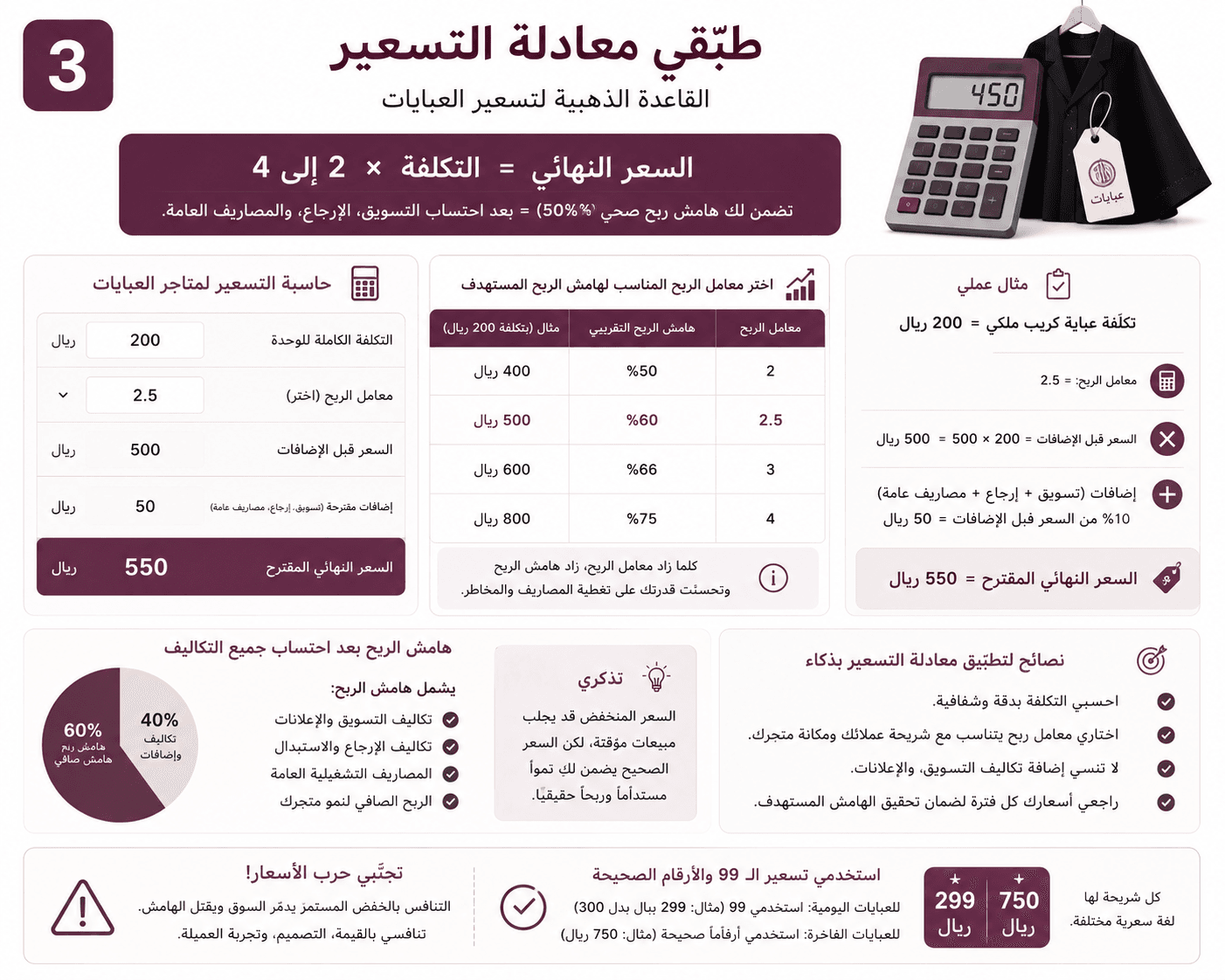
Final price = cost × 2 to 4. This rule secures a healthy margin of 50% to 75% after accounting for marketing, returns and general overheads. The multiplier you choose within that range is a positioning decision: closer to 2 for high-volume everyday pieces, closer to 4 where the work, the fabric or the brand justify it. What the rule protects against is the instinct to add a small markup to cost and call it a price, which reliably produces a business that cannot afford to advertise.
4. Compare against competitors in your tier
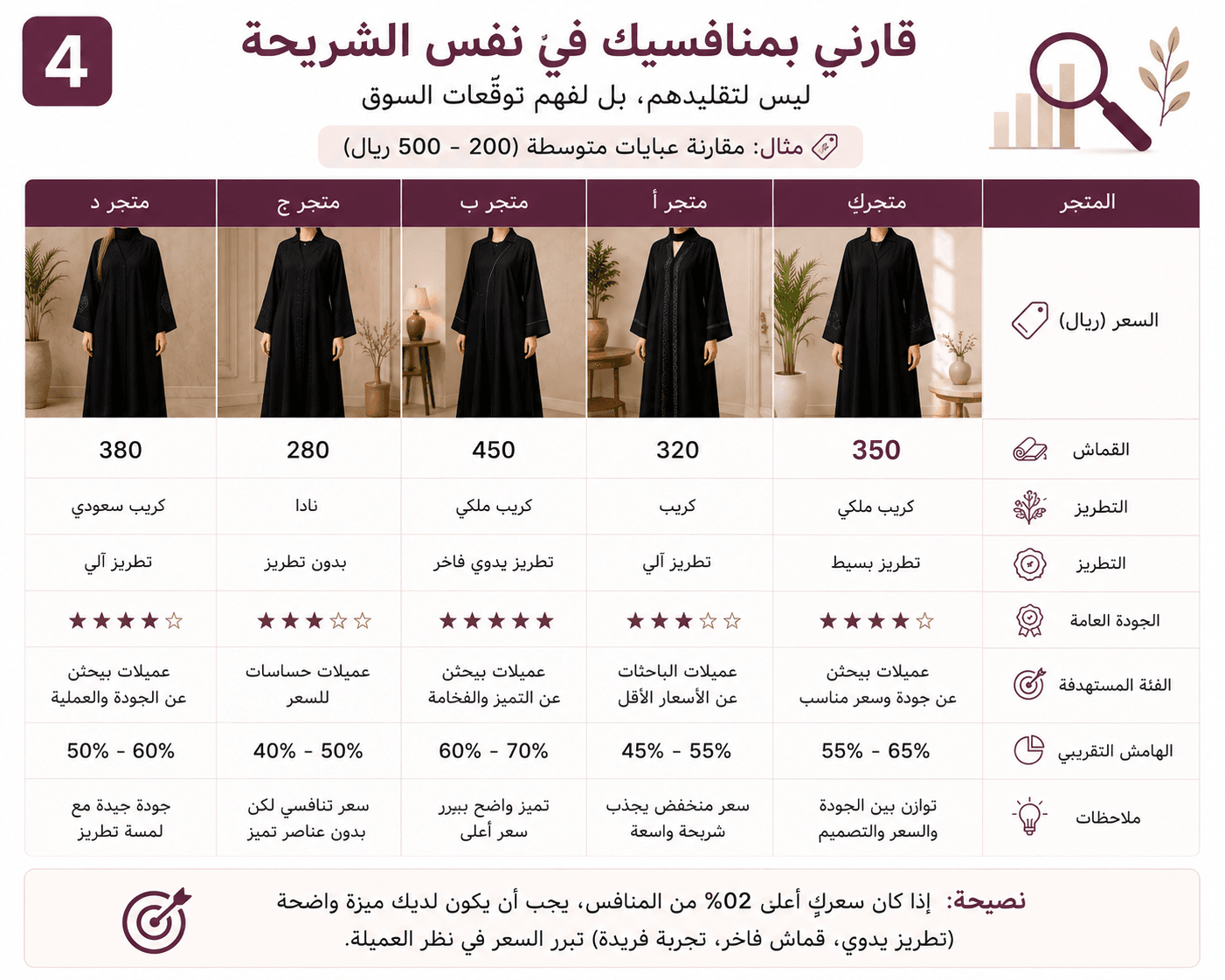
Look at competitors in the same tier — not to copy them, but to understand what the market expects at that price. If your price is 20% above a competitor's, you need a clear, visible advantage: hand embroidery, premium fabric, a distinctive experience. A higher price with no legible reason for it reads as an error rather than as positioning.
5. Price on value, not on cost
Your customer is not buying fabric and tailoring. She's buying a story, a feeling, an occasion, an experience. Pricing on perceived value opens higher margins without requiring you to compromise on quality — in fact it usually requires the opposite, because perceived value has to be earned somewhere. Cost-plus pricing caps you at whatever your supplier charges plus a fixed multiple, which means your ceiling is set by someone else's invoice.
6. Review your pricing every 3 months
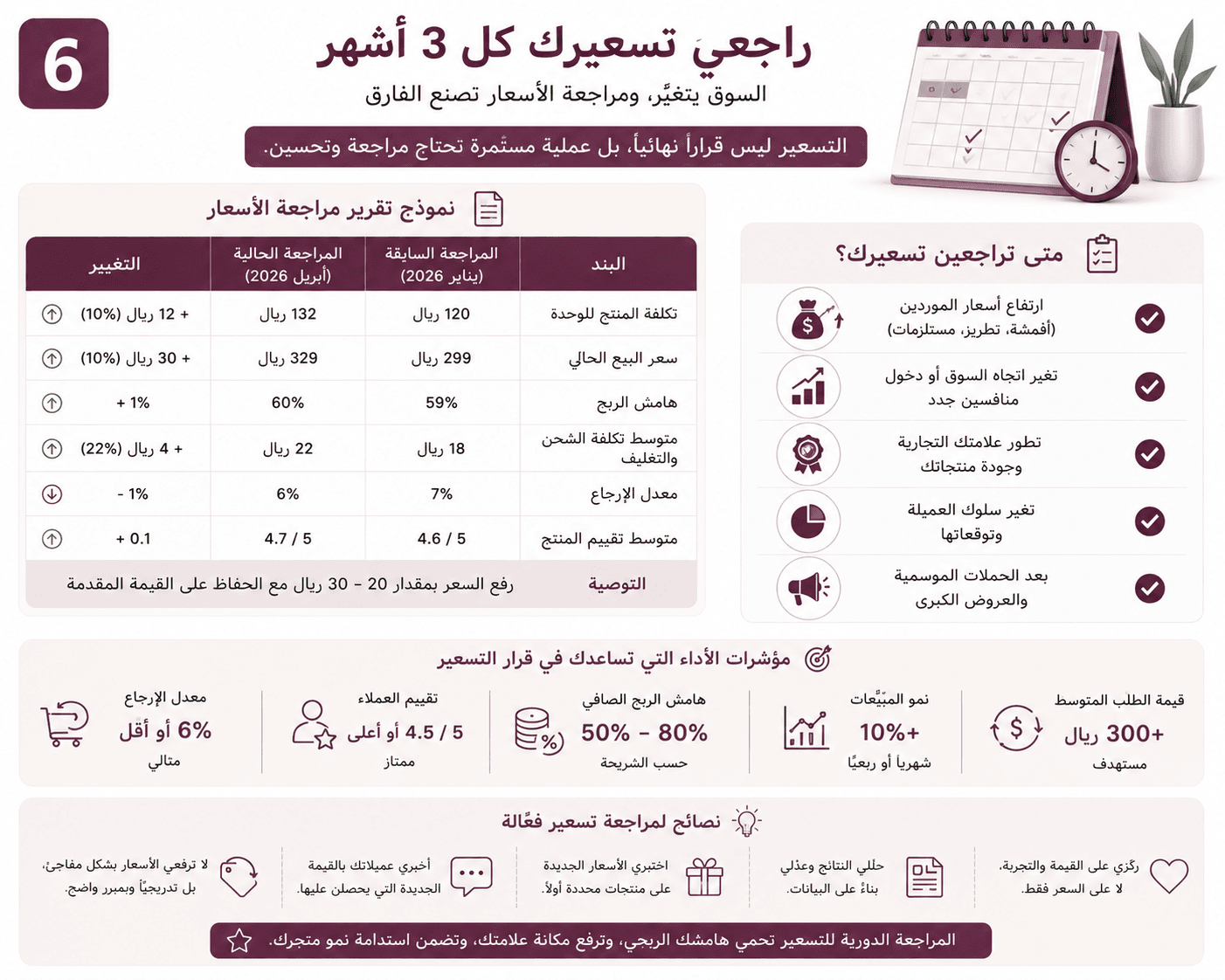
Markets move, supplier prices move, and your brand's position moves. Pricing is not a decision you make once, it's a process that needs revisiting and refining. A quarterly review is frequent enough to catch a margin quietly eroding, and infrequent enough that customers don't experience your prices as unstable.
📝 Important notes
⚠️ Avoid price wars. Competing by cutting continuously destroys the market and kills the margin. Compete on value, design and customer experience instead.
✅ Use 99-pricing (SAR 299 instead of SAR 300) for everyday abayas, and whole numbers (SAR 750) for luxury pieces. Each tier has its own pricing language, and the charm-price signal that helps in economy actively cheapens a luxury piece.
🎯 What a healthy margin looks like
Margins vary by tier, and the target rises as the tier does — partly because expectations rise, and partly because volume falls:
- Everyday abayas: 50% to 65% after all costs
- Occasion abayas: 65% to 75%
- Luxury abayas: 70% to 80%
Below 40% is not a sustainable business once marketing spend and returns are accounted for. If your current numbers land there, the answer is almost never to sell more — volume multiplies a bad margin rather than fixing it.
❓ Frequently asked questions
What is a healthy margin in the abaya business?
For everyday abayas: 50% to 65% margin after all costs. For occasion pieces: 65% to 75%. For luxury: 70% to 80%. Below 40% means the margin is not sufficient to sustain the business once marketing and returns are accounted for.
Should I start with low prices to attract my first customers?
No. A low price is difficult to raise later and sets a permanent impression of your brand. Start at your correct price and offer discounts to early customers framed as a limited launch offer instead.
How do I handle customers who always ask for a discount?
Tie the discount to a condition — an order above SAR 500, a first order, a repeat purchase. An unconditional discount teaches the customer never to buy at full price and wastes your margin.
Where does the 2 to 4 multiplier come from?
It's the range that leaves a 50% to 75% margin once marketing, returns and overheads are subtracted. A multiplier of 2 produces roughly 50%; a multiplier of 4 produces roughly 75%.
How often should I change my prices?
Review every 3 months. Reviewing does not mean changing — most reviews should confirm the price is still right. What matters is that a supplier price increase or a market shift never goes unnoticed for a year.
📖 Further reading
- A feasibility study for an abaya business
- How to choose an abaya supplier
- Getting ready for White Friday: a guide for abaya merchants
Smart pricing turns an ordinary store into a profitable brand. Don't be afraid of your price — make it reflect what your product is actually worth.
Ready to put it into practice? Create your store for free and start pricing properly from day one.