The platform you pick on day one is the one you will still be living with three years from now.
Choosing where to build an abaya store feels like a formality when you start. It isn't. The platform is the foundation your whole business sits on, and the differences between one platform and another almost never show up in week one. They show up later, when you want a payment method your customers actually trust, when the tax authority asks for compliant invoices, when an order has to reach a customer in another Gulf country, and when you are trying to make a product page do justice to embroidery you spent weeks getting right. In this guide, you'll learn what actually separates one platform for selling abayas online from another in the Saudi market, and why more than 70,000 Saudi merchants have built their brands on Salla.
The best platform for selling abayas online in Saudi Arabia is the one that ships with the market already built in: local payment methods such as mada, Tabby and Tamara, ZATCA e-invoicing compliance, direct integrations with Saudi shipping carriers, a genuinely Arabic RTL storefront, fashion-ready themes, and Arabic-speaking support. Salla covers all six out of the box.
📌 Article overview
- Why the platform decision matters more for abayas than for most categories
- The six criteria for choosing an abaya platform in the Saudi market
- What each criterion costs you when the platform gets it wrong
- Frequently asked questions
- Further reading
🧭 Why this decision is heavier than it looks
Every platform can list a product, take a card and send an order confirmation. That is the easy 20% of the job, and it is the part every sales page shows you. The hard 80% is everything that sits underneath: whether a customer in Riyadh can pay the way she expects to pay, whether your invoices satisfy Saudi e-invoicing rules without you buying a third-party app, whether a shipping label prints in one click or in eleven, and whether the store reads as a native Arabic experience rather than a translated one.
Abayas make all of this sharper. It is a visual, detail-driven, size-and-color-heavy category with a high average order value at the top end and a customer who compares carefully before she buys. A platform that handles fashion badly costs you conversions on every single product page, not once.
📝 Important notes
The differences below are not theoretical. Each one has a direct cost — in integration fees, in monthly app subscriptions, in staff time, or in abandoned checkouts.
✅ The six criteria for choosing an abaya platform
These are the six things worth checking before you commit, in the order they tend to hurt if you get them wrong.
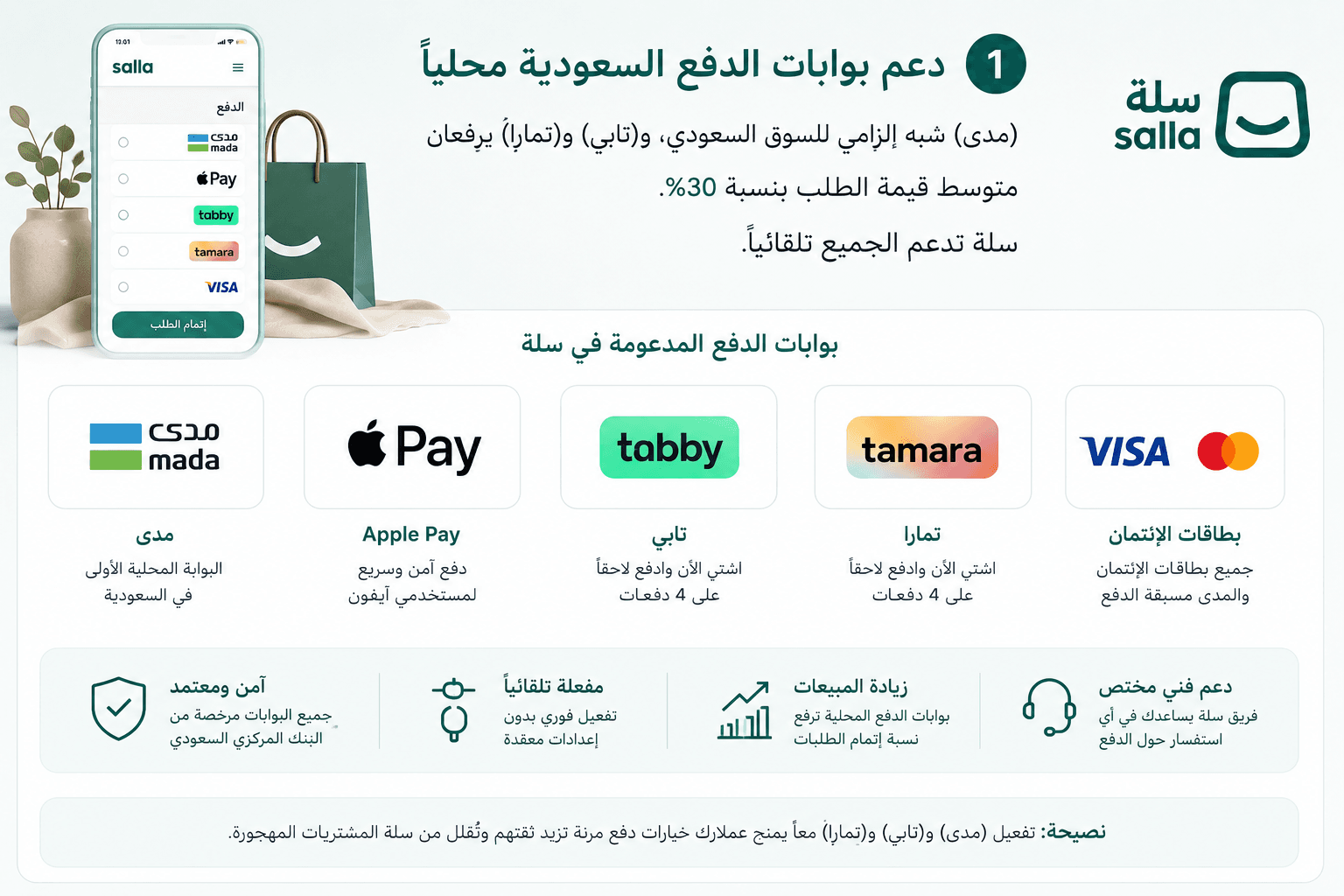
1. Native support for Saudi payment gateways
mada is effectively non-negotiable in the Saudi market. If a customer reaches checkout and her card isn't accepted, you have paid for the traffic, earned the interest and lost the order at the last step. Beyond mada, deferred payment matters more in abayas than in most categories, because a large share of the catalog sits above the price point people pay for casually. Tabby and Tamara lift average order value by 30%, which is the difference between a customer buying one everyday piece and buying the occasion abaya she actually wanted.
Salla supports all of them automatically. International platforms generally require paid integrations and intermediary providers to reach the same place, and every one of those is another contract, another fee and another thing that can break.
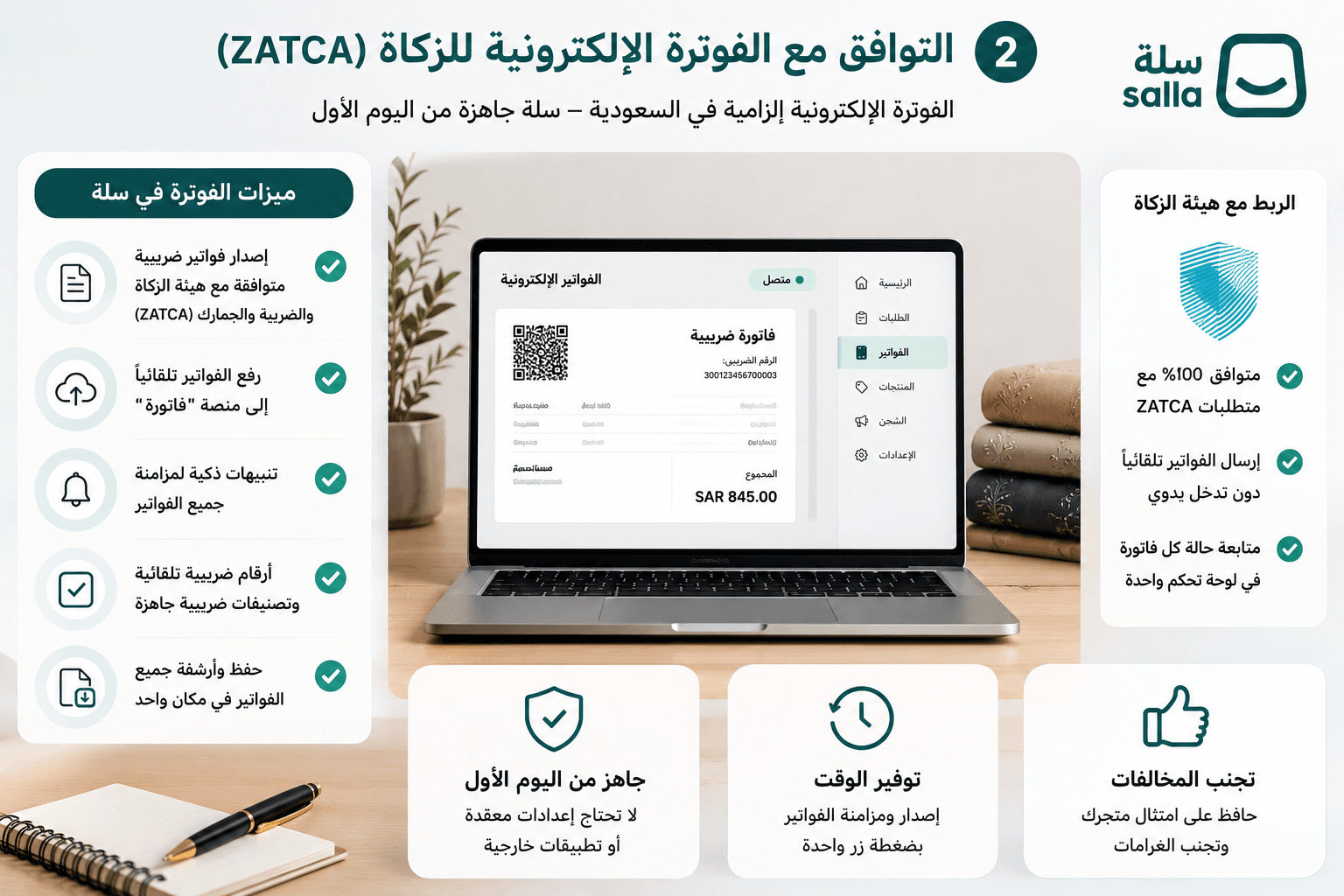
2. ZATCA e-invoicing compliance
Electronic invoicing is mandatory in Saudi Arabia. This is not a feature you can decide to add later when you have time. Salla is compliant from day one, so the invoice your customer receives and the record you keep both satisfy the requirement without any action on your part. On international platforms, e-invoicing typically means an external application and additional cost — a recurring expense attached to a legal obligation, which is the worst kind of recurring expense.
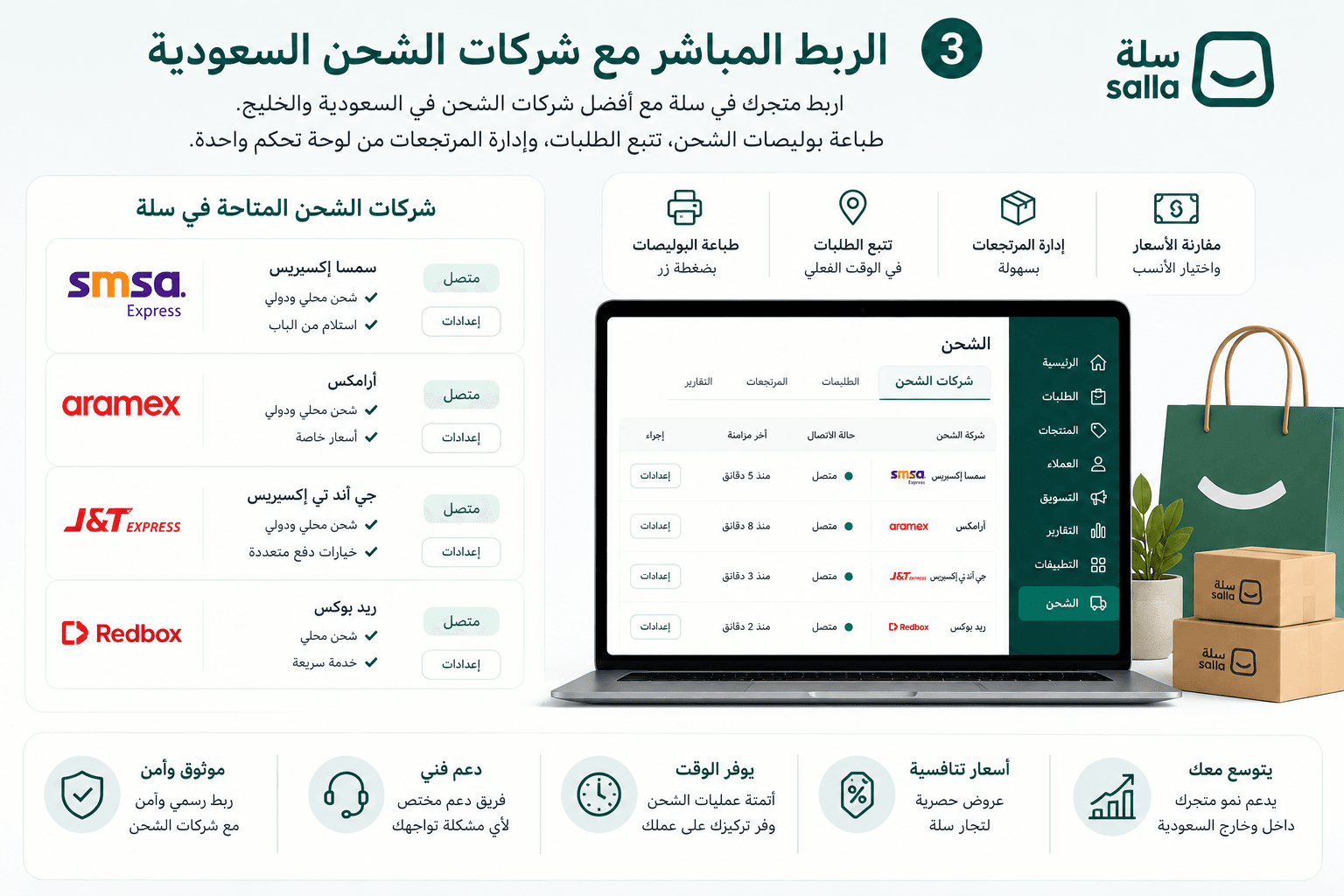
3. Direct integration with Saudi shipping carriers
SMSA, Aramex, J&T and RedBox are the carriers your customers already recognize, and recognition matters at checkout. The practical question is whether the integration is direct. Direct means you print a waybill with one click from inside your dashboard. Indirect means copying addresses between systems, which is slow at ten orders a day and impossible at a hundred. Salla ships these integrations inside its plans rather than selling them separately.
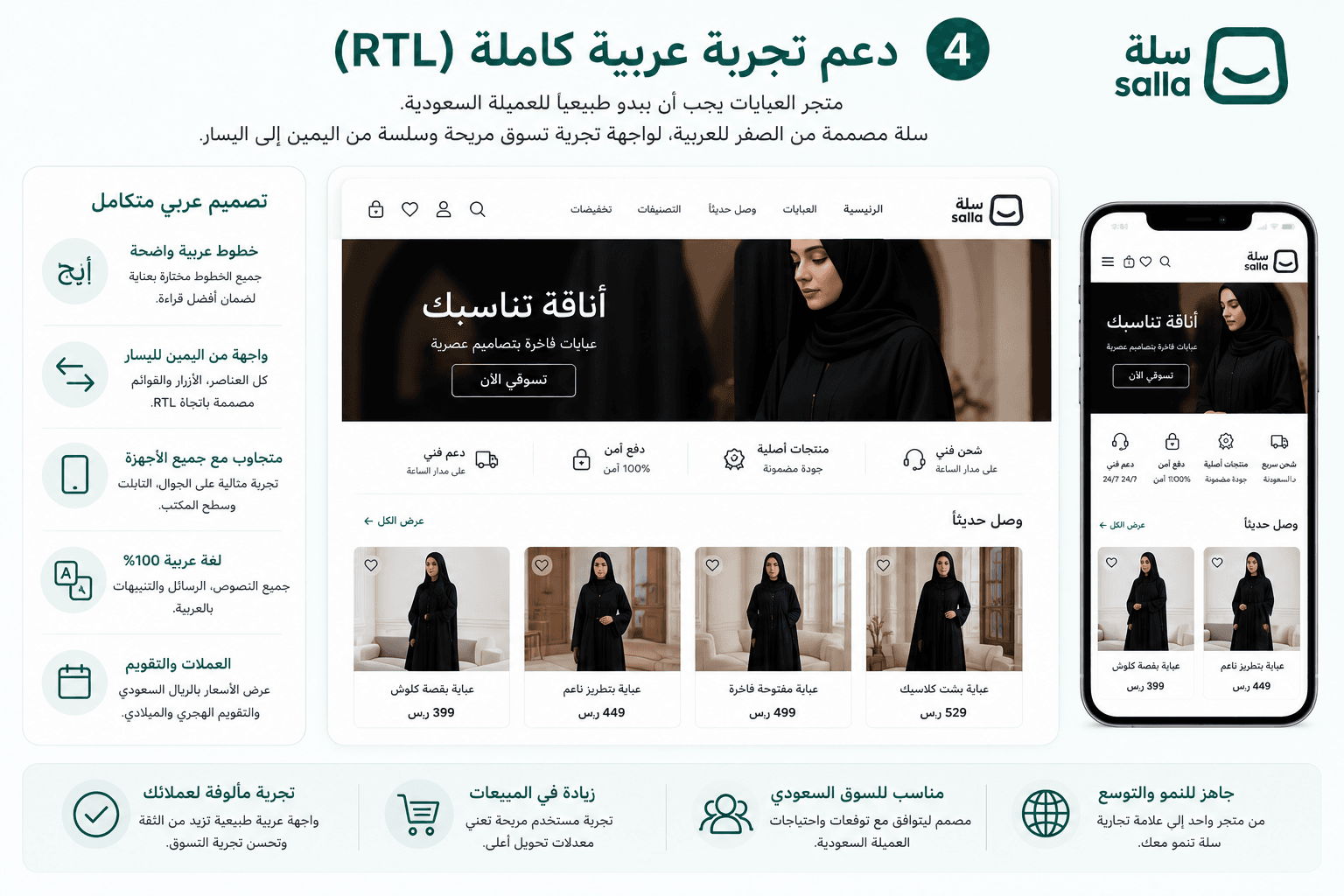
4. A genuinely Arabic, right-to-left experience
An abaya store has to feel natural to a Saudi customer, and that feeling is built out of a hundred small details — where the price sits, which way the gallery arrows point, how a size selector reads, how a form behaves when you type into it. Salla was designed for Arabic from the ground up. International platforms translate and adapt, and adaptation leaves seams. Individually each seam is trivial. Together they produce a store that feels slightly foreign, and a customer who feels slightly unsure is a customer who leaves to think about it.
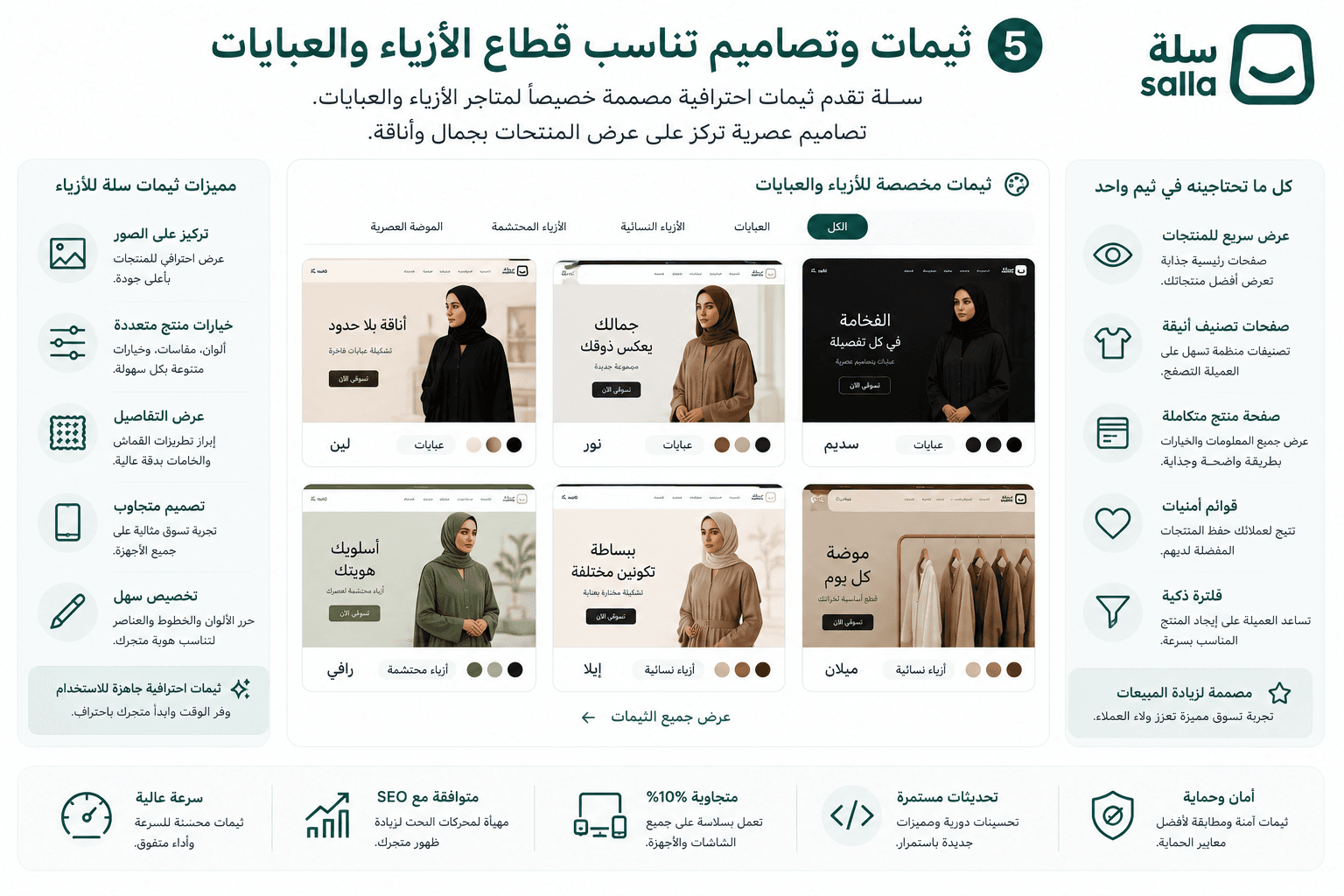
5. Themes built for fashion, not adapted to it
A generic theme treats a product photo as an illustration of a listing. A fashion theme treats the photograph as the product. Salla offers themes designed specifically for the fashion and abaya sector: visual layouts that put images first, multi-option product handling for size and color, and presentation that lets hand embroidery and fabric detail actually register at the resolution people browse at. When your differentiator is craftsmanship, the theme is not decoration — it is the only way the craftsmanship reaches the customer.
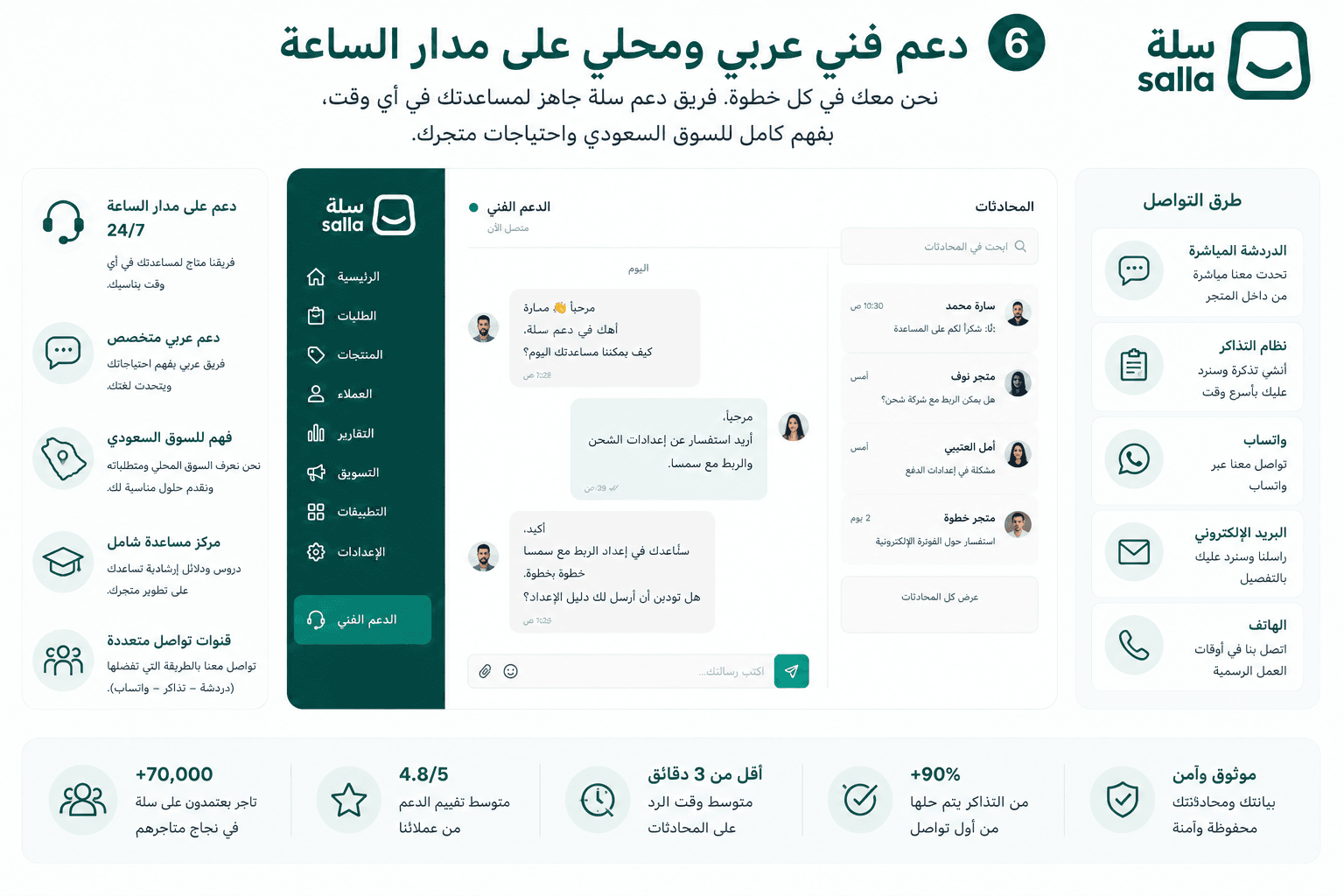
6. Arabic-speaking, local support
Support quality only matters on the day something breaks, and on that day it matters more than every other feature combined. What you need then is someone who understands your context without a translation layer — who knows what mada is, what a ZATCA invoice looks like, and why a shipment to Dammam behaves differently from one to Jeddah. Salla provides Arabic support 24/7. International platforms support you in English, from teams without visibility into the specifics of this market.
💡 Scale check: Salla today serves more than 70,000 merchants across Saudi Arabia and the Gulf, including thousands of abaya merchants running stores with monthly sales in the millions.
📝 Important notes
You can try Salla for free before committing to a plan. For most new abaya stores, the Basic plan is enough to launch on and grow into.
❓ Frequently asked questions
Is Salla suitable for small stores and first-time merchants?
Yes. Salla offers plans that fit every size, from a store that has not taken its first order to an established fashion label. You can start on a small plan and move up as the business grows, without rebuilding anything.
What is the main difference between Salla and Shopify for an abaya store?
Readiness for the Saudi market. Salla arrives with mada, Tabby, Tamara, e-invoicing and Saudi shipping carriers already integrated. On Shopify, each of those is a separate configuration or an additional app.
Can I move my existing store to Salla?
Yes. Salla provides a product import tool for migrating from other platforms, and a dedicated team helps you move your data across without losing your customers or your order history.
Do I need technical skills to use Salla?
No. Salla is built to be used by business owners with no technical background. The interface is a straightforward Arabic dashboard, and a setup wizard walks you through the process step by step.
Which criterion should I weigh most heavily?
Payments, because it is the only one that costs you a sale at the moment of purchase. Compliance and shipping cost you time and money; a failed checkout costs you the order outright.
📖 Further reading
- How to start a successful abaya business in Saudi Arabia
- How to create an abaya store on Salla
- The best Salla themes for abaya stores
The right platform saves you months of work you would otherwise spend building around the wrong one. Judge platforms on the six criteria above rather than on the feature list, because the feature lists all look the same and the day-to-day reality does not.
Ready to start? Create your store for free and set up your abaya store.