Have you ever built an ad that looked great and still went nowhere?
The problem is usually not the colors or the photography. It is the words. Strong ad copywriting is what gets into a reader's head and moves them from watching to buying. It is also a skill, which means it can be learned. In this guide, you'll learn what ad copy actually is, twelve steps for writing an ad people remember, and the persuasive words that do the heavy lifting.
Ad copywriting is the craft of writing words that persuade someone to act — buy, sign up, or simply notice your brand. It works when you understand the product, understand the reader, lead with a headline that earns attention, translate features into benefits, and close with a clear call to action.
📌 Article overview
- What ad copywriting is and why it matters
- The types of ads that need sharp copy
- 12 steps to writing an ad people remember
- Persuasive words that lift your response rate
- Frequently asked questions
💡 Ad copywriting basics
What is ad copywriting?
Copywriting is the art and the science of influence through language. It is the skill of shaping a sentence so it changes what the reader thinks and pushes them toward a specific action — buying a product, signing up, or just paying attention to your brand for the first time.
🎯 Why the copy matters
Your design, your expertise, and your offer only mean something once the words give them meaning. Good copy:
✅ Forms the foundation of any campaign that works.
✅ Lifts your search performance and your conversion rate.
✅ Gives your brand a voice people recognize.
Put simply: without strong text, a beautiful ad is worth nothing.
✍️ Who can write it?
You can hire a professional copywriter, or you can write it yourself. It is a skill you build with practice — as long as you learn the rules below and apply them deliberately.
📣 The types of ads that need sharp copy
- Social media ads: short, direct lines that spark curiosity or earn the click.
- Brand campaigns: copy that builds awareness and attachment to the brand.
- Email ads: copy that persuades a defined audience to buy or engage.
- Product ads: copy built around convincing features and benefits.
- Paid ads: copy that has to stop someone within a few seconds.
- Website copy: copy that guides the visitor through the site and lifts conversions.
🚀 12 steps to writing an ad people remember
1. Know your product deeply
Understand its features, its benefits, and why this particular customer needs it. Every word you write should answer one question: what do I get out of this?
2. Know your audience
Who are they? What is on their mind? What problem are they trying to solve? An ad works when it speaks the customer's language rather than the advertiser's.
3. Write like a conversation
- Write the way you'd talk to a friend. Say "you" more often than you say "we."
- Nobody enjoys being lectured at. People respond to being spoken with.
4. Open with a headline that takes the attention
The headline is the doorway to everything else. Make it:
Clear and direct.
Curious enough to pull the reader in.
Specific about the benefit it promises.
💡 Example: "Write an ad that sells in 5 minutes — without sounding like you're selling."
5. Cut it down until every word sells
- Say only what has to be said.
- You have roughly eight seconds of attention. Don't spend them on a warm-up.
6. Write to sell, not to fill space
- Attach the idea to a feeling.
- Create a need, or promise relief from a real frustration in a way that's enjoyable to read.
- Every sentence should earn the next one.
7. Find the right marketing tone
Every ad is a mix of information, incentive, and offer. Balance the three and you stay honest and persuasive at the same time.
8. Separate the feature from the benefit
- Feature: what the product does.
- Benefit: what the customer gets out of it.
💡 Example: "a comfortable 5 cm heel" becomes "stay on your feet all day and still feel good."
9. Don't tell them everything
Say just enough to make the reader want the rest. A measured amount of mystery is what creates curiosity.
10. Use the rule of three
Three words, three points, the message repeated three times. The mind holds on to sets of three.
💡 Examples: "Simple, fast, effective." / "Write. Test. Improve."
11. Write a call to action worth acting on
Close with a line that makes the next step obvious.
💡 Examples:
"Start free now"
"See the details"
"Download your first guide to ads that work"
12. Know where the reader is in the buying journey
Do they already know you, or is this the first time they've seen your name? Write for the stage they are actually at — awareness, interest, or decision.
You may be targeting someone who already knows your brand, or someone who has never heard of you. The point of this step is to identify the stage the person you are targeting is in. These are the stages every buyer moves through before deciding to buy (the buyer's journey):
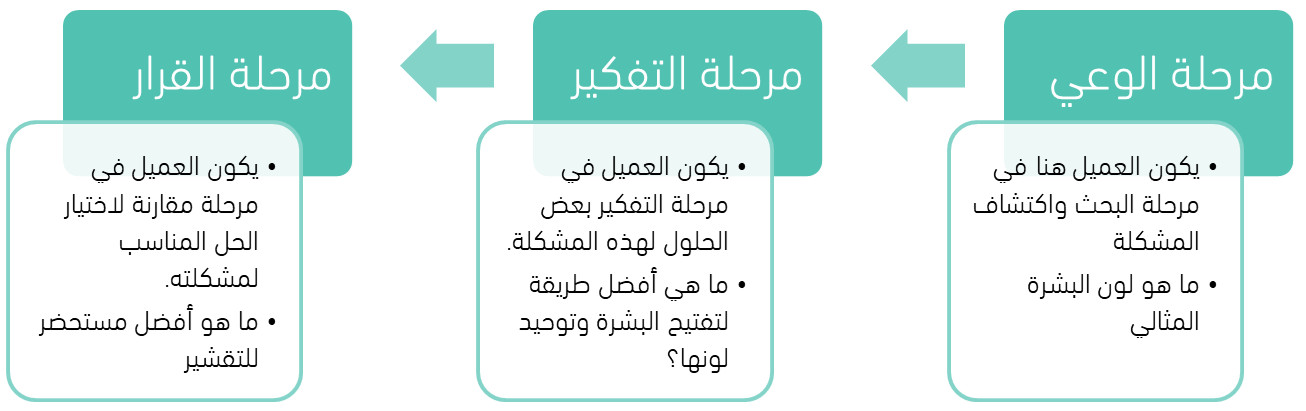
💡 Example: say you're promoting a facial exfoliator. Instead of "this cream will exfoliate your skin in a week," lead with the benefit: "get fresher, more even, visibly brighter skin in 7 days — with no effort at all."
📝 Important notes
Read your copy before it goes live. Spelling and grammar mistakes cost you credibility faster than any weak headline does.
🧠 Persuasive words that lift your response rate
Certain words consistently make an ad more interesting. They are what earns the click and what tips a reader into buying. Here are the ones worth keeping close, and how to use each without wearing it out.
Word type | Words that work | How to use them |
| Personal connection | you, yours, yourself, just for you | Speaks straight to the reader and makes the message feel personal. Don't overuse it, or it starts to sound staged. |
| Urgency and speed | now, immediately, today only, before it's too late | Pushes a fast decision. Use it carefully, or you lose credibility and create needless pressure. |
| Value and free | free, at no cost, on us | Extremely good at grabbing attention. Make sure the free offer is genuine and hides no later commitment. |
| Newness and excitement | new, for the first time, never released before, upgraded version | Creates curiosity and ties your brand to innovation. Only use it when something has genuinely changed. |
| Results and guarantees | guaranteed, proven results, certain | Gives the reader a sense of safety. Avoid promises that are exaggerated or impossible to verify. |
| Scarcity and exclusivity | exclusive, limited, rare, members only | Creates a feeling of prestige and urgency. Save it for special offers rather than everyday products. |
| Motivation and achievement | achieve, gain, succeed, get started, rise | Suits headlines aimed at ambition. Keep the sentence positive and built on a verb so it actually motivates. |
| Saving and value | save, discount, special price, great deal | Very effective during a promotion. Pair it with a precise figure (save 20%) to make it credible. |
| Transformation and change | change your life, refresh your routine, build your skill | Works for educational ads and self-improvement products. Don't overstate the outcome. |
| Trust and reliability | trusted, certified, rated ⭐⭐⭐⭐⭐ | Back it with real testimonials or ratings so the claim holds up. |
| Trying and discovering | try, discover, enjoy, experience it | Suits trial content or a first launch. Tie it to a clear, distinctive experience. |
| Emotion and belonging | because you deserve it, for you, together, we believe in you | Builds an emotional link with your audience. Skip it in purely transactional contexts, where it reads as fake. |
| Ease and simplicity | easily, in one step, effortlessly | Removes the fear of complexity. Ideal for tech products and digital services. |
| Concrete results | in 7 days, in minutes, remarkably fast | Use it when you can actually deliver. Watch for exaggeration and unrealistic timeframes. |
| Social proof | best seller, used by thousands, the first choice | Persuades through social proof. Add real numbers wherever you can. |
| Inspiration and ambition | imagine, dream, start your journey | Appeals to emotion and to a future vision. Use it in storytelling and inspirational ads. |
| Comfort and reassurance | safe, easy to use, worry-free | Effective for health and financial products. Use it to settle a reader's concerns. |
| Quality and distinction | premium, refined, high quality, the experts' choice | Creates a sense of luxury. Pair it with images and design that support the idea. |
| Challenge and proof | try it yourself, compare, take the test | Use it in comparison or trial campaigns, but be ready to back the claim up. |
| Time and timing | within the day, in 5 minutes, this week only | A strong way to put a limit on time. Only use it when the deadline is real. |
| Uniqueness and personalization | made for you, built to order, a one-of-a-kind experience | Use it for customizable products or premium services. It reinforces the sense of individual attention. |
| Scientific or professional proof | research-backed, from experts, clinically tested | Adds real credibility in health and education. Never use it without genuine evidence. |
🔔 Remember: the right word at the right moment sells more than a campaign with a million-riyal budget behind it.
❓ Frequently asked questions
Do I need to hire a copywriter?
Not necessarily. Copywriting is a skill you can build with practice. Learn the rules in this guide, apply them consciously, and review your own work before it goes live.
How long should an ad be?
Only as long as it needs to be. You have around eight seconds of a reader's attention, so open with the benefit and cut anything that isn't selling.
What's the difference between a feature and a benefit?
A feature is what the product does. A benefit is what the customer gets. "A comfortable 5 cm heel" is a feature; "stay on your feet all day and still feel good" is the benefit — and that is what people buy.
Can I use urgency words in every ad?
No. Words like "today only" and "before it's too late" work when the deadline is real. If you use them when nothing is actually ending, you spend your credibility for a short-term click.
Should I write the same ad for new and returning customers?
No. Someone who already knows your brand needs a different message from someone seeing it for the first time. Match the copy to the buyer's stage: awareness, interest, or decision.
Every copywriter finds their own way of landing a message. What you need is the tactic — then the practice to make it yours.